Risk of poisoning
Until around 4-5 years of age, the risk is high. Children's curiosity knows no bounds and they often experiment by tasting, tasting everything. We discussed some of these issues at risk of drowningBut there is a risk of accidental ingestion of dangerous substances found in the home.
The number of children exposed to toxic substances is worrying.
The likelihood of this happening is so high that this risk requires an individualised approach.
Exposure to toxic substances can have an immediate effect and then we act, we go to the doctor, but there is also the long-term effect of repeated exposure. This exposure can cause serious diseases and health problems.
We bring up again Mum's tiredness and stress. It is the main cause of most unwanted situations and accidents in children.
Main prevention measures:
- We always keep substances in their original packaging.
Toxic substances - DO NOT put them in other bottles that look like something "tasty" (in juice bottles, water bottles etc)
- Always close the lid after use. They are somewhat difficult for a young child to open and if we have absurdly omitted to store the container in a place inaccessible to the child, it will be harder for them to get at the contents.
We don't do our nails, we don't colour our hair around the baby, and if we go to the salon, we don't keep the baby with us in the room where they use substances for colouring, hairdressing etc
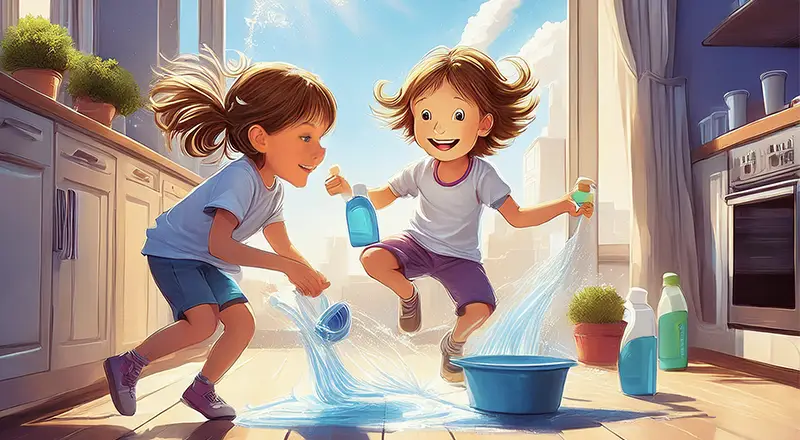
- At home, we take care where we store our cleaning supplies. We don't leave detergents and cleaning supplies lying around. We store them where the baby or toddler has no access. We can, for example, fit a lockable cupboard and put all the substances that can harm the baby in there.
- Never leave bottles of cleaning solutions or other substances that may be toxic to children next to the toilet bowl. It is also safer not to use those cleaning substances that are applied inside the toilet bowl in the form of gels or soaps. Babies can get into the bath if they have started "travelling", climb on the bowl and "taste" a bit of what they find. The risk is maximum for children between 1-2 years of age. We can use them if we make sure that the child does not end up alone in the bath.
- When cleaning the bathroom, e.g. the bathtub, do not leave small children near you. There is a risk of irritation by touch or inhaling the vapours of the substances applied. He may touch surfaces coated with cleaning solution with his hand and put his hand to his eyes or mouth. We may not even realise it, being focused on the cleaning, and after a while we notice irritation, bumps etc. in the child
- I insist, toxic solutions are stored where the child has no access. We also take care in the closet, garage, so that the child does not have access to these areas where various harmful substances may be stored.
- In the kitchen, also pay extra attention to where you store cleaning solutions. Children are not allowed unsupervised in the kitchen. In addition to cleaning substances, there are also sharp objects, plugged accessories and many other hazards.
When we administer medicines to children, we never associate them with chocolates, sweets, candy etc.
- We don't say "let's give mummy something sweet and boooun", "come on, a syrup like a candy". It's good for the child to know that he is taking a medicine because he is sick, it is prescribed by the doctor, and that medicine makes him well and that's all. We don't give him a little bit because he asks and because he likes it, he really needs to know the role of medicines and teach him that if you take it without being necessary and recommended by the doctor, it makes you sick. We tell them from a young age and keep repeating it so they grow up with the lesson learnt. The association with sweets will make the child, when he gets his hands on a medicine, swallow it whole. Or "come on take this syrup, it will turn you into a dinosaur" be sure he will look for it when you are not paying attention and will drink 3 bottles if he finds it, to turn into his favourite dinosaur or character. Take extra care when administering medication to children or other family members in the presence of children.
- We do not paint the house with a baby around and we do not put the baby to bed in a freshly painted room. Check the product label and follow the manufacturer's instructions. If these are not clear, call your paediatrician and ask when you can put your baby to bed in a room that has recently been painted. We follow the manufacturer's and paediatrician's recommendations exactly.
If you suspect that you have swallowed a toxic substance, call the emergency number and/or your paediatrician and you will receive expert advice on how to act. If you have the container, take it with you to the hospital and present it to the doctor, it is necessary to tell him what substance he swallowed, how much and when.

Leave a comment